


A deployment can succeed and still leave the most important question unanswered: is what’s running in Production the same thing we tested?
For many Boomi teams, the honest answer is “probably”. And “probably” gets expensive the moment an integration that passed every test starts misbehaving in Production.
That uncertainty rarely comes from Boomi. It comes from the release process around it: packages rebuilt by hand for each environment, approvals scattered across email threads, settings that differ quietly between Test and Production. Each step seems reasonable on its own. Over dozens of releases, they add up to what we call promotion drift, the slow gap between what was validated and what is actually running.
At Hathority, we see this pattern across industries. The good news is that it’s a solvable problem, and most enterprises already own the tools to solve it: Boomi and Azure DevOps. This post walks through the model we use: one principle, a clear split of responsibilities, and five controls.
Where Manual Releases Break Down
Manual promotions rarely fail dramatically. They fail in the questions a team can’t answer when it matters:
- Is the package in Production provably the one we tested?
- Who approved this release, and where is that recorded?
- Why does UAT behave differently from Test when nothing “changed”?
- If we need to roll back, what exactly do we roll back to?
When those answers live in people’s memories instead of in the system, every release carries more risk than it should.
One Principle: Build Once, Promote the Same Package
The foundation of a trustworthy pipeline is simple. Build the integration package once, then move that exact package through every environment.
In practice, the pipeline asks Boomi to create the package a single time. Boomi gives it a unique identifier, and Azure DevOps carries that identifier forward to Test, then UAT, then Production. No environment gets a fresh build, and no approval is followed by a quiet rebuild. If something needs to change, that’s a new run, with a new package and a fresh set of approvals.
It sounds obvious. But it’s the difference between hoping Production matches what you tested and knowing it does.
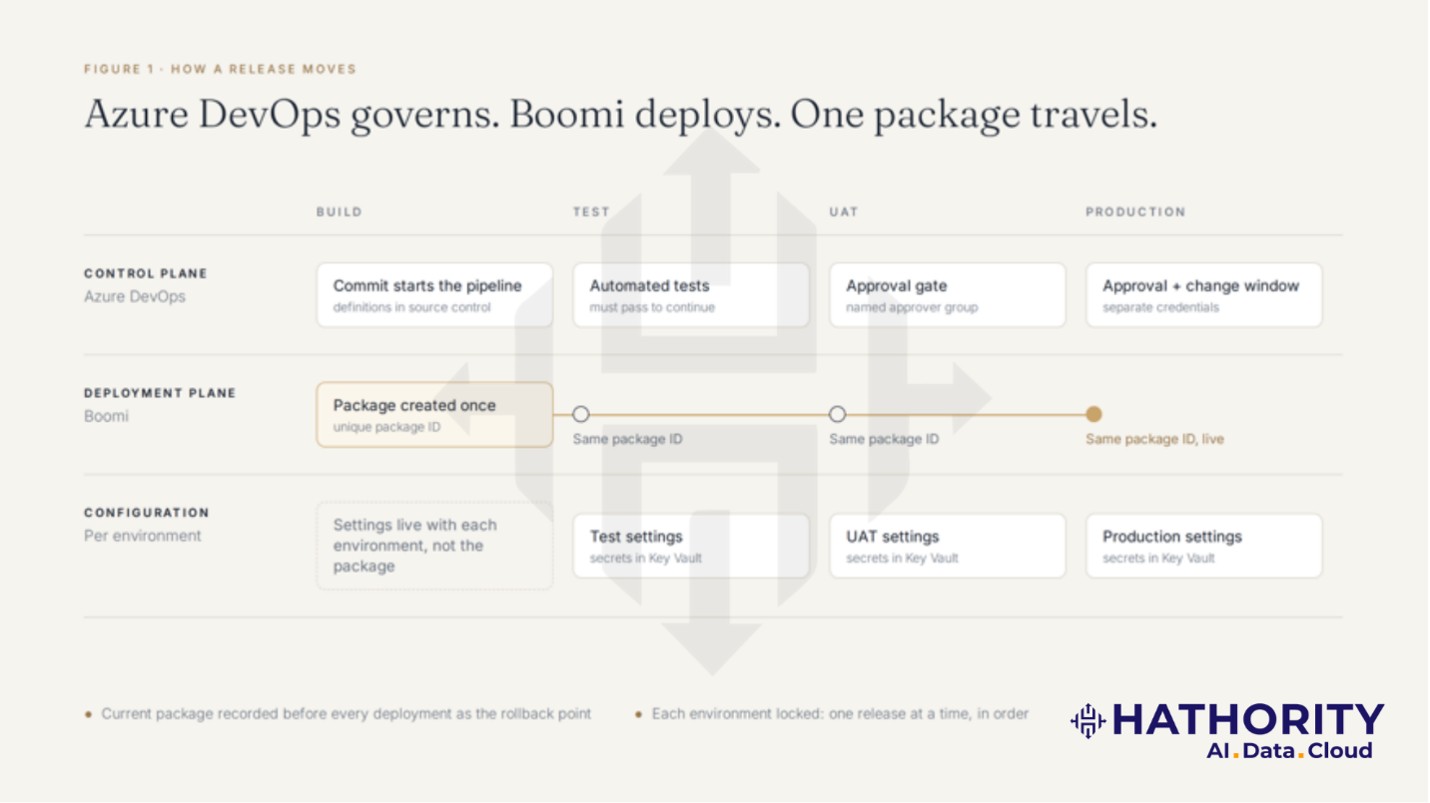
Figure 1. Azure DevOps governs, Boomi deploys, and one package travels unchanged from Test to Production.
Letting Each Platform Do What It Does Best
A common mistake is asking one tool to do everything. This model works because it draws a clear line between the two.
Azure DevOps is the control plane. It keeps the pipeline definitions in source control, runs each stage in order, enforces approvals, and records the audit trail.
Boomi is the deployment plane. It creates the package, owns its identity, and deploys it into each environment.
Environment-specific settings, such as endpoints, credentials and process properties, follow their own governed path. They belong to the environment, not the package, so they are managed separately and checked before every deployment.
The pipeline wraps governance around Boomi rather than replacing it. That keeps the design simple and lets Boomi do the job it was built for.
Five Controls That Earn Trust
Promoting the same package solves drift. Earning the confidence of security, audit and business stakeholders takes a little more. These are the five controls we consider essential.
- Approvals that can’t be bypassed. UAT and Production approvals sit on protected environments in Azure DevOps, each with its own group of approvers. Nobody can remove them by editing a pipeline file. Production adds an agreed change window and its own, separately scoped credentials.
- Configuration handled on its own terms. The same package still needs different endpoints and credentials in each environment. Those values are kept in an approved, version-controlled record for each environment, and secrets stay in Azure Key Vault, never in code and never in logs.
- Testing before promotion. A successful deployment only tells you Boomi accepted the package. It doesn’t tell you the integration works. Automated smoke and functional tests run after Test, and UAT waits until they pass.
- One release at a time. Each environment is locked while a deployment runs, so two approved releases can never collide, and they always land in the order they were approved.
- A way back, planned in advance. Before every deployment, the pipeline records what is currently running. If something goes wrong, recovery means redeploying that known-good package through the same approval path. It is a deliberate decision made by a person, never a silent automatic rollback and never a rebuild of old code.
What Changes for Your Team
The payoff shows up in everyday work, not just at audit time:
- Releases become routine instead of events that need a war room.
- Every deployment traces back to a commit, a pipeline run, a package and a named approver.
- Credentials are tightly scoped and never exposed.
- Pipelines run on Azure DevOps Managed DevOps Pools, so there is no build server to patch and look after.
- Once the pattern works for one integration, reusable templates extend it to the next fifty.
Moving Forward
On a whiteboard, this pipeline takes an hour to sketch. Making it dependable across a real integration landscape, with the right security controls, network boundaries and governance, is where most of the effort goes.
That’s the work Hathority does every day. As a Boomi Platinum Partner with 350+ Boomi certifications and 3,000+ integrations delivered, we help enterprises replace manual, error-prone promotions with release pipelines they can trust and audit.
If your Boomi releases still depend on manual packaging and approvals in email, we’d welcome the conversation.
CEO Statement

Vishwam Annam, CEO at Hathority:
“Every enterprise today has access to vast amounts of data, yet many still struggle to trust it. The difference lies in the foundation. A strong, well governed data layer transforms data from a challenge into a strategic advantage. At Hathority, we are committed to helping organizations build that foundation enabling them to move from uncertainty to confident, data driven decision making.”